
Pakistan’s Identity Makeovers | De-Islamising Place Names is the New Fashion in Town
By Murtaza Shibli
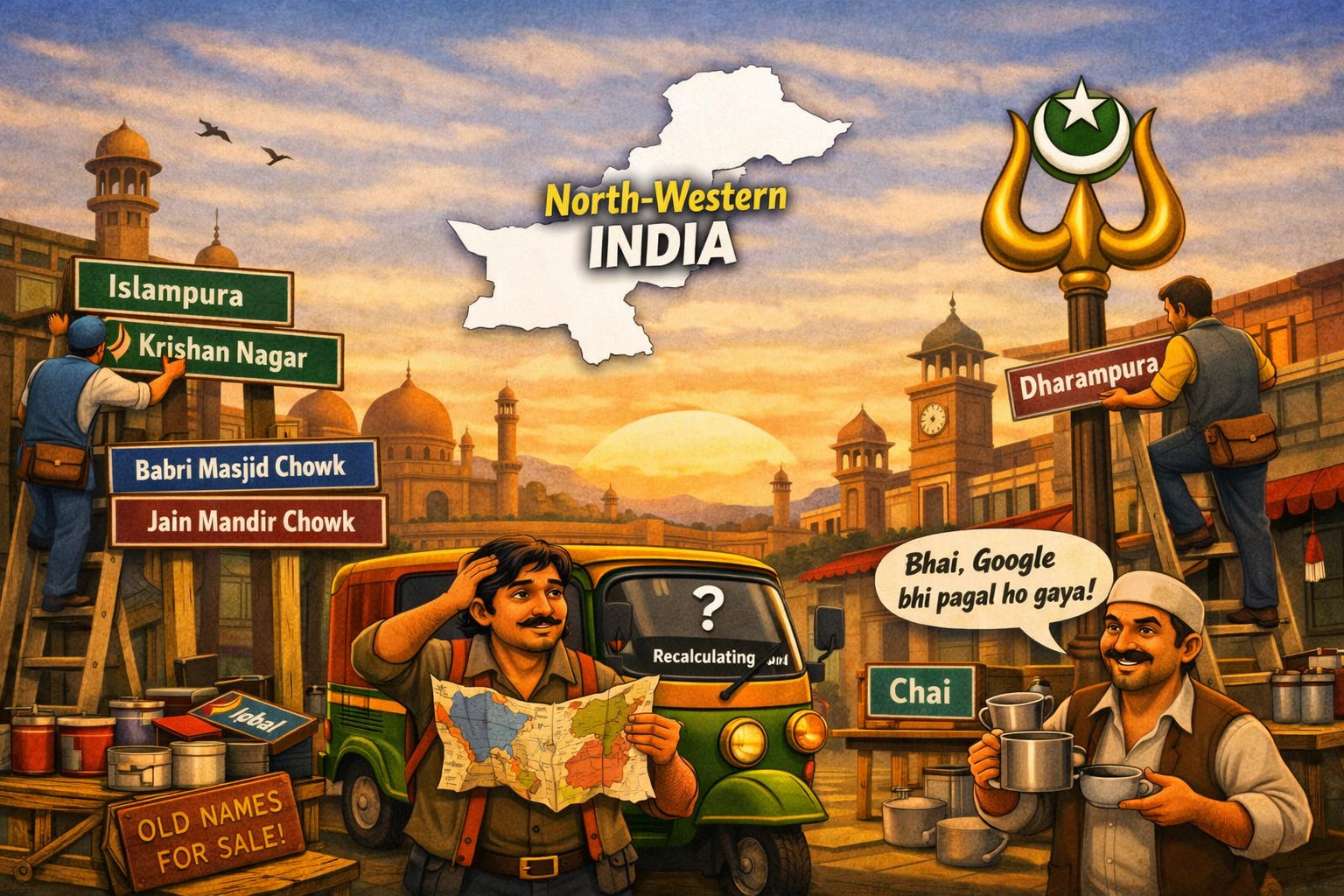
If there were an Olympic event for “Most Frequent National Reinvention,” Pakistan would not just win gold—it would demand the medal be renamed, Islamised, de‑Islamised, and then restored to its pre‑Partition nomenclature.
Since 1947, the country has been trapped in a loop: invent identity, perform it loudly, discover it no longer suits the geopolitical season, discard, repeat. Somewhere between “Land of the Pure,” “Frontline State of the Free World,” “Epicentre of Jihad,” and “Enlightened Moderate Ally,” the basic question—what is Pakistan, actually?—got lost under layers of slogans, uniforms, and freshly painted signboards.
Born Confused
Pakistan’s founding story is well known: Muslims of the subcontinent needed a separate homeland. What’s less often emphasised is the demographic punchline—at Partition, more Muslims remained in India than ended up in Pakistan. The “homeland” for Muslims was, numerically speaking, next door.
The ideological glue was “Islamic identity,” but the Islam in question was not a single, serene river; it was a delta of quarrelling streams. By the late 19th and early 20th centuries, Deobandi and Barelvi scholars had turned mutual takfīr into a literary genre—pamphlets, fatwas, public munāẓaras, entire careers built on proving the other side was outside the fold. This wasn’t a side-show; it was the main theatre of religious life in North India.
That entire sectarian architecture—its rivalries, its obsessions, its love of public denunciation—was carried into Pakistan intact. No customs duty, no inspection. The new state claimed to be founded on Islam, but which Islam was left deliberately vague. That vagueness would later prove extremely useful.
The Secular Founder with a Posthumous Halo
Then there was the small matter of the man fronting this Islamic homeland: Muhammad Ali Jinnah. Western-educated, impeccably tailored, whisky on the table, cigarettes in hand, he was about as close to a European liberal constitutionalist as South Asian politics could produce at the time. His personal religiosity was private, his politics resolutely legal‑constitutional, not clerical.
Yet, after his death, he was routinely adorned with the honorific formula used for saints and pious scholars – rehmatullahi alaiyh – may Allah be pleased with him, an honorific used primarily for deceased saints, ulamā, and pious figures who are not Prophets or Sahaba, the companions of Prophet Muhammad, alaih-i-salam. The theological retrofit was necessary: if Pakistan was to be sold as a divinely tinged project, its founder needed at least a symbolic halo. So, the state did what it does best—rewrote the script after the performance.
The early decades of Pakistan were dominated by generals, civil servants, and landed elites whose lifestyles were often more club‑room than cloister. But the rhetoric was Islamic, the speeches were Islamic, the resolutions were Islamic. The country perfected a unique political technology: govern like a colonial state, speak like a revivalist pamphlet.
1971: New Identity Crisis
Then came 1971. The eastern wing broke away to become Bangladesh after a brutal civil war and military crackdown. The “two‑nation theory” suddenly looked less like a timeless truth and more like a fragile political slogan that had just failed its first major stress test.
Into this crisis stepped General Zia‑ul‑Haq, who overthrew Zulfikar Ali Bhutto and decided that if Pakistan lacked a coherent identity, it would be given one from above—Sharīa‑flavoured, Arabic‑accented, and heavily militarised. Islamisation became state policy: Hudood laws, zakat ordinances, compulsory prayer in offices, and a general attempt to recast the republic as something between a barracks and a seminary.
Symbolism followed substance. Local, regional, and colonial names were steadily replaced with Islamic ones. Roads, parks, neighbourhoods—anything that sounded too Hindu, Sikh, or British was rebranded. History was not just interpreted; it was curated, trimmed, and renamed. The message was clear: Pakistan was not merely a post‑colonial state; it was the latest outpost of a transhistorical ummah.
Jihad, Inc.
Conveniently, this Islamisation drive coincided with the Soviet invasion of Afghanistan. Suddenly, Pakistan’s new identity was not just ideologically satisfying; it was strategically profitable.
The country became the staging ground for the Afghan jihad. Money, weapons, and fighters flowed through its territory. Intelligence agencies midwifed militant groups. Madrassas multiplied. Jihad was marketed as both religious duty and foreign policy instrument.
Missiles, operations, and training camps acquired Islamic names. The state’s Islamic vocabulary and its security apparatus fused into a single narrative: Pakistan as the sword‑arm of the free world and the faithful. For a brief, heady moment, the country’s identity, its ideology, and Washington’s strategic needs were perfectly aligned.
Of course, this harmony was rented, not owned.
2001: From “Strategic Asset” to “Problem”
On 11 September 2001, the same jihad‑centric identity that had been cultivated for decades became a liability overnight. The United States, once the chief sponsor of anti‑Soviet militancy, now wanted a “war on terror.” The very networks that had been nurtured were suddenly reclassified as threats.
General Pervez Musharraf, reading the room with admirable speed, announced a new doctrine: “enlightened moderation.” The phrase was so elastic it could cover everything from cracking down on some militants to hosting beauty pageants, but its purpose was clear — signal to Western capitals that Pakistan was under new, more palatable management.
Former “freedom fighters” would overnight find themselves on wanted lists. Some were killed unceremoniously, others ceased from their bedrooms and quietly sold to the US for monies that lined the pockets of the Generals; even Pakistan sold its own citizens for booty including women. The state that had once celebrated jihad now sold its former protégés as evidence of cooperation. The identity dial had been turned again—this time from “vanguard of jihad” to “responsible, moderate ally.”
The ideological U‑turn was not accompanied by a deep reckoning. It was, as usual, a change of costume, not character.
Lahore’s Signboards: A National Mood Board
Fast‑forward to today, and the identity theatre has moved to the streets—literally. Lahore, Pakistan’s cultural capital, has begun restoring pre‑Partition names to neighbourhoods and roads that had been Islamised over the decades.
Islampura is now officially Krishan Nagar again. Babri Masjid Chowk has reverted to Jain Mandir Chowk. Sunnat Nagar is back to Sant Nagar. Mustafaabad has become Dharampura. Maulana Zafar Ali Khan Chowk is once more Lakshmi Chowk. Fatima Jinnah Road is now Queens Road; Bagh‑e‑Jinnah is again Lawrence Gardens. A whole cluster of colonial and Hindu‑Sikh names—Davis Road, Brandreth Road, Ram Gali, Empress Road, Outfall Road—are being restored under a heritage revival project backed by the Punjab government, headed by Maryam Nawaz, a grandmother who can give run to teenage girls running on a beauty pageant.
The official line is heritage conservation, and that is certainly part of it. But it also functions as a mood board for Pakistan’s latest self‑presentation: less ideological, more “inclusive,” more palatable to a world tired of headlines about Islamic extremism.
The same state that once scrubbed Hindu and colonial names off the map in the name of Islamic authenticity is now repainting them in the name of cosmopolitan heritage. The compass hasn’t broken; it’s just spinning in sync with external expectations.
Across the Border: The Mirror Image
Meanwhile, India is busy doing the opposite. Allahabad has become Prayagraj. Faizabad is now Ayodhya. Mughalsarai Junction is Deen Dayal Upadhyaya Junction. Gurgaon is Gurugram. Aurangzeb Road in Delhi was renamed after A.P.J. Abdul Kalam. Where Pakistan is restoring Hindu, Sikh, and colonial names to signal a return to plural heritage, India is erasing many Muslim‑associated names to assert a majoritarian civilisational narrative. One is repainting the past to look less Islamic; the other is repainting it to look less only Islamic.
If the subcontinent were a stage, this would be the scene where both actors accidentally swap scripts and keep performing.
The Name Game, Taken to Its Logical Conclusion
All of this raises an awkward but unavoidable question: if you can rename neighbourhoods, roads, parks, and squares every few decades to match the ideological fashion of the moment, what exactly is sacred?
Even the name “Pakistan” itself began life as an acronymic invention—Punjab, Afghania (historically referring to the North-West Frontier Province), Kashmir, Sindh, Baluchistan. Coined in the 1930s as a catchy label for a proposed federation, around the same time as Procter & Gamble formalised the discipline of brand management.
Given the country’s history of identity makeovers, it’s not entirely absurd to imagine that in the not-so-distant future, Pakistan could be rebranded as ‘North-Western India’ reaffirming its roots in old Hindustan. This shall really give India a run for its money while challenging the newly installed Hindutva monopoly over the idea of India and its history.
It might sound ridiculous—until one remembers that Islampura really has become Krishan Nagar again, and Babri Masjid Chowk is now renamed in the memory of Jain Mandir Chowk. The absurd is already policy; it just hasn’t reached the letterhead.
The Constant in All This
Beneath the comedy, there is a serious pattern. Pakistan’s identity has rarely been defined inward, through a settled social contract or a stable constitutional culture. It has been defined outward—against India, in alignment with Washington, in response to Moscow, in service of Riyadh, in the shadow of Kabul.
Islamisation under Zia aligned with the anti‑Soviet jihad. “Enlightened moderation” aligned with the post‑9/11 security order. Today’s heritage revival and de‑Islamisation of signboards align with a world that wants Pakistan to become more presentable to the forces that seek to de-Islamise the region – from the Middle East to Central Asia – and perhaps in sharp contrast to the Islamic Republic of Iran that stands isolated for its resolve to stand firm in whatever version of Islamic identity it believes in.
The signboards of Lahore are not just urban furniture; they are a barometer of how the state wishes to be seen this decade.
The tragedy—and the dark comedy—is that beneath the layers of renaming, rebranding, and repackaging, the core questions remain unanswered: What is the basis of citizenship? What is the relationship between religion and the state? What does justice look like beyond slogans? What does it mean to be Pakistani when the answer keeps changing with every cabinet meeting and every foreign policy pivot?
Until those questions are faced honestly, Pakistan will continue to excel at the one thing it has truly mastered: performing itself differently every few years, while remaining fundamentally unresolved.